


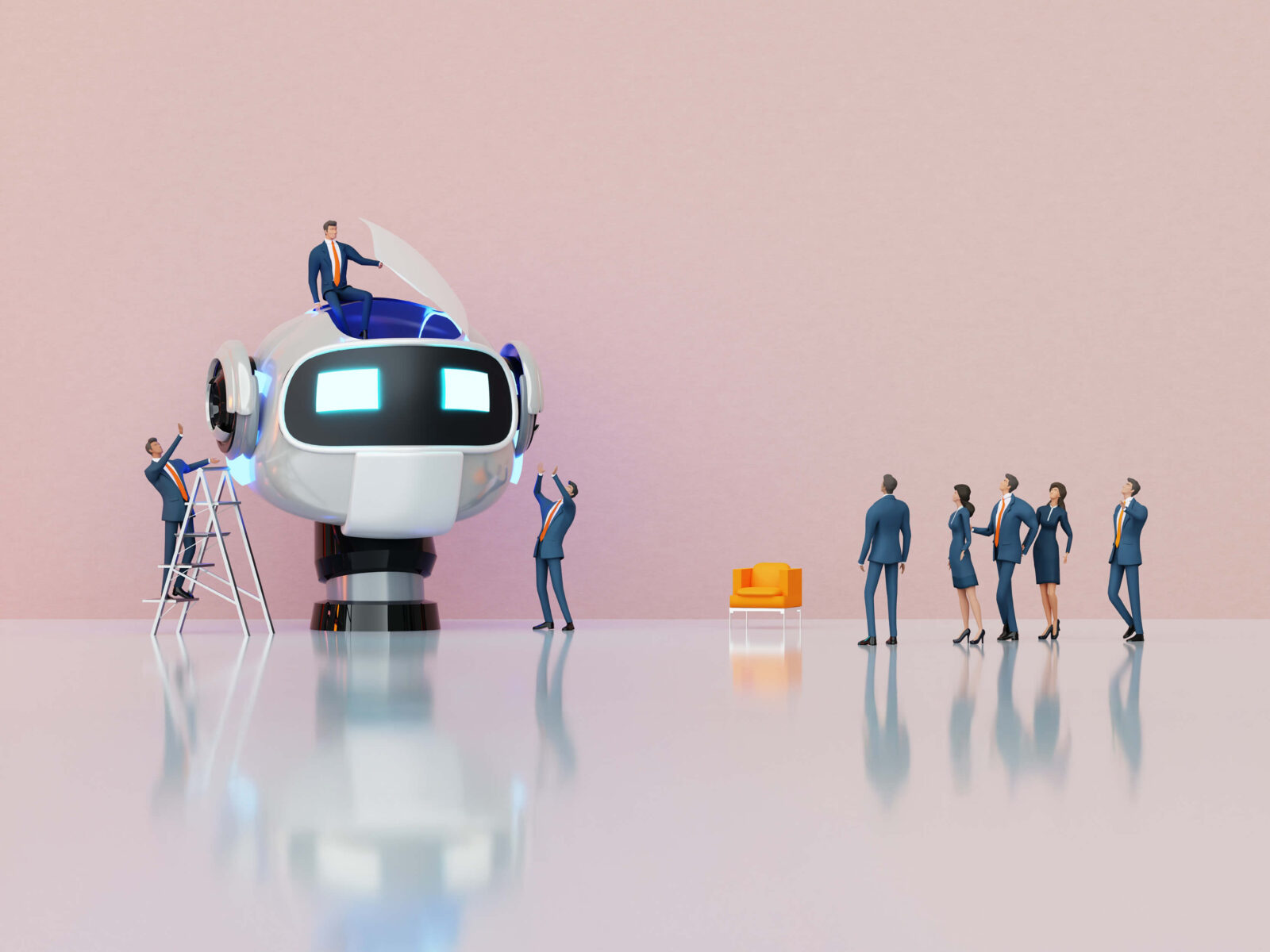
An MIT course in AI confirmed that humans are still essential for authentic communications, while an overreliance on machines could sell your business short
Over a journalism career spanning decades, I have watched the industry transform from taking print titles online to embedding AI tools directly into newsroom workflows. With AI reshaping almost every area of working life, I wanted to understand its powers and pitfalls more thoroughly. My goal was to both equip myself for the next stage of my career and to apply what I learnt responsibly.
The search sent me to the Massachusetts Institute of Technology (MIT), whose course on Applied Agentic AI for Organisational Transformation, with its focus on software that acts autonomously once it is tasked, was an ideal fit.
Studying part-time over several months, I had access to AI expertise in the form of senior MIT faculty members alongside an external tutor whose CV included work at both Google and Deloitte. One overarching message – that AI needs constant and effective human monitoring – was repeated often throughout the course. This advice is what continues to ring most loudly in my ears, not least after recent incidents of unauthorised hacking by autonomous agents.
My time studying also made me think hard about a more practical question – when we should and should not use AI. Many organisations in all kinds of industries are currently wrestling with this critical issue. So, here are my key takeaways from my studies about the use of AI within media, marketing and communications, and its implications for writing material that people not only want to read but can trust.
Words matter
Inevitably, jargon featured prominently during my technology-themed course. One phrase I heard repeatedly was keeping humans in the loop – one of the core principles for the safe deployment of AI agents. I would like to suggest another equally important principle, too: knowing when to remove AI from the loop – or at least curtail its use.
Large language models (LLMs) are extremely useful for research and for helping to galvanise ideas, but when it comes to writing in a way that will connect with your fellow humans, that is original and has meaning, there is no substitute for writing in natural language. Authenticity can only come from humans.
A scientific report published earlier this year by npj Artificial Intelligence, part of the Nature journal group, demonstrated that LLM-generated language routinely sounds empathetic but lacks the personal tone and narratives common in human interaction. Public opinion about the use of AI-generated content, meanwhile, remains at best lukewarm, and at worst hostile, according to surveys. One by global research data and analytics group YouGov in the UK summarised one key finding as: “No business sector receives a net positive trust score for AI use”.
A numbers game
Keeping humans firmly at the helm chimes with recent experience in the wider business world. Boston Consulting Group, for example, suggests a “10-20-70” formula for successful execution of projects involving AI, meaning that algorithm use brings 10% of value to projects; technology implementation brings another 20%; and everything else – the 70% – comes down to people. Looking at this from a media or marketing perspective, we might allot 10% of effort to research using LLMs, 20% to fact-checking that research and structuring, and 70% to human writing, production and sign-off.
The temptation to throw everything at our LLM of choice and see what comes out the other end, while understandable, is a mistake. The output is usually what I would call bad AI writing. It has common traits that many people, not least journalists, can spot a mile off. When we do, it dilutes our trust in what is before us.
Recently, multiple authors of opinion articles for prominent news outlets were found to have used AI to write or edit their contribution. This includes one academic leader whose article was about students using AI to cheat. The use of plain English has therefore never been so important for authenticity, not least for personal and brand reputations. We still place great store on originality.
Throughout my MIT course, tutors repeatedly warned that the ill-considered, rushed deployment of AI has consequences – and real business impact. Publishing misleading or inaccurate content, that has not been fact-checked by a human, carries real regulatory and legal risks. Brand reputations and brand value suffer when this happens.
Even as industries rush to automate, I believe quality will increasingly stand out. Writing generated by a human brain will take on greater value in this new landscape, despite a trend in some areas to replace headcount with chips and tokens. That is not to rubbish the sheer genius of human achievement in creating the technology capable of doing what AI does.
The opposite of the slop produced at immense speed by LLMs is human connection. People respond to people, which is why advertisements often feature actors and celebrities, and why, with a few exceptions, news stories about people generally have bigger audiences than stories about issues.
A sloppy business
The high-profile release of the ChatGPT iPhone app in 2023 was cited by my MIT tutors as a watershed moment. It resulted in a proliferation of “digital fiction” on platforms such as Amazon’s Kindle. Even academic journals weren’t immune, with the Washington Post reporting that an American professor had produced more than 200 papers in a year, which he admitted was assisted by AI.
While publishing volumes are up, overall quality has fallen. But I believe a backlash is coming. Creating masses of content in the hope that some of it will be of value is all the more reason to look ahead to a resumption of quality over quantity. Targeting your budget and your effort deliberately in a very considered way makes much more sense than mass production just because you can.
This article was written by a human being (me)*. When I fed just the headline into ChatGPT and asked it to write a version for me based on that alone, the resulting article was immediately identifiable as AI generated. The tone was urgent and breathless, the subheadings (example: “Trust is still a human business”) were frequent and trite, and the writing reminiscent of the worst LinkedIn posts I have had the misfortune to read.
For many this will be good enough to meet their needs, and as LLM frontier models go from strength to strength, perhaps the artifice in this linguistic output will disappear. But for those who wish to have a lasting connection between brand and reader… well, you can make up your own mind. Personally, I’m with the MIT experts: the human touch remains essential.
*It was also edited by a human team at FirstWord




Leave a comment